Parishes of Elstead, Thursley, Shackleford & Peper Harow, website
St. Nicholas Church
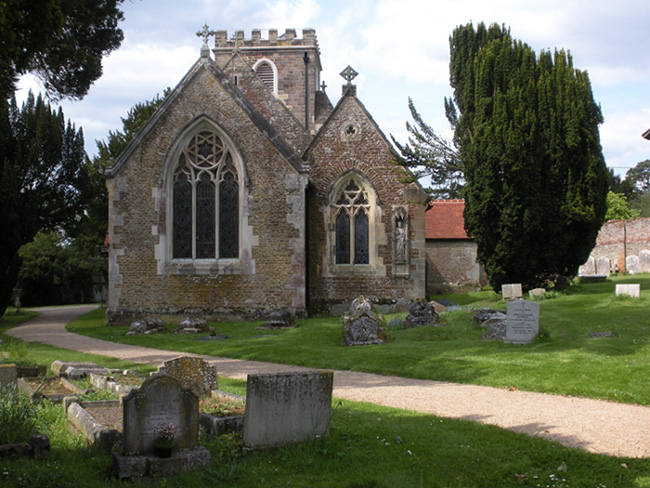
Founded in Norman times, very little remains of the original medieval building which was constructed in local sandstone rubble, with dressings of clunch, covered with Caen stone dressing. In 1826 a western tower of coursed stone was added, replacing a wooden bell-turret with shingled spire. There were 3 bells, all dating from the 17th Century, all lost in the fire of
The interior of the church contains many monuments, tablets and inscriptions. Outside there is an ancient sundial and a terracotta figure overlooking a grave which is a relative of Churchill. The lychgate is somewhat unusual nowdays; it was used to rest the coffin before taking it into the church or churchyard.
Augustus Welby Pugin (1812-1852) changed the face of this small church. A convert to Catholicism, Pugin believed that Gothic was the true Christian architecture and in 1841 published ;True Principles of Pointed or Church Architecture'. His work at Allan Towers brought him to the attention of wealthy patrons and Lord Midleton commissioned him to decorate his estate in Surrey and Ireland.
Pugin commenced work at St. Nicholas in 1844. He departed from a pure Gothic style and set about creating a history of medieval English Church styles - the Norman chancel arch, the 'violent' Early English aisle/arcade and the decorated chancel. His additions include the north aisle, the Mortuary Chapel, the tower arch and the chancel windows. The door knob has engraved on it JULY 24 1877. The use of neo-Norman style is almost unique in Pugin's work.
goto to Top
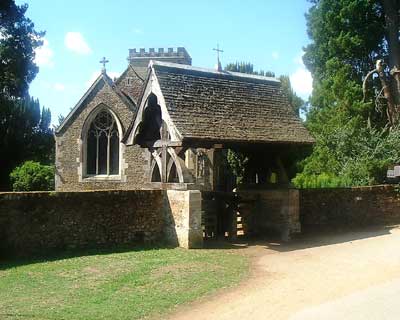
The Lych Gate with coffin rest.
 Facing North East
+ I AM THE RESURRECTION AND THE LIFE +
Facing South West+ TO THE GLORY OF GOD, AND IN MEMORY OF HARRIET, WIDOW OF WILLIAM JOHN 7th VISCOUNT MIDLETON, BORN AUG 10 1804, ENTERED INTO REST AUG 13 1893 AGE 89, THIS LYCH GATE IS ERRECTED BY HER ONLY DAUGHTER +
goto to Top
Spiritual
For some, Peper harow is an ancient and sacred place of healing and tranquillity.
It is probable that this was a Saxon holy place, and due to the presence of Bonville Springs, a 'holy well' close to the River Wey, (see:Bonville Spring) Peper Harow may have been a place of pilgrimage. The ancient Yew tree in the churchyard has been dated at over 600 years old, and some local belief puts its age at 1000 years.
It is not unusual that pagan sites were occupied by early Christian settlers, and indeed, that the Pope's advice to Mellitus, first bishop at St. Paul's in London in 604, was that this practice should be pursued.
goto to Top
Cistercian Presence
The Cistercian Order was founded as an offshoot of the Benedictine Order and its monks wore light-coloured (undyed) woollen cloth in contrast to black-robed Benedictines. A silent order, the Cistercians placed great importance on manual labour. A large number of lay brothers, often local peasants, laboured with the monks growing crops as well as managing oxen and sheep.
Oxenford Grange, forming a boundary of the Peper Harow estate, was one of several sites in the area where grain and farm produce were stored by the monks. In the 12th Century, a devastating flood on the river flats forced the brothers to abandon this spot for higher ground close to Waverley Abbey.
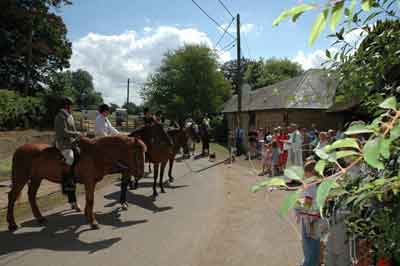
St. Nicholas Church, Peper Harow holds services every Sunday and a family service each month. During the year, several Country services are held to mark Lammastide, Rogation Sunday, to bless the Plough and in the Harvest, and a special Horse Service is held to bless these animals.
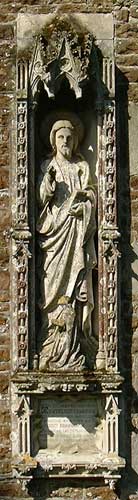
The inscription in the panel under the statue of St Nicholas reads :
To the Beloved Memory of Kathleen Brodrick 4th Daughter of R Brodrick esquire and wife of Henry Brodrick. 4th Son of the 7th Viscount Midleton.
* Born 4th July 1837 Married September 10 1862 Died July 31 1867 *
goto to Top
The Old Yew Tree
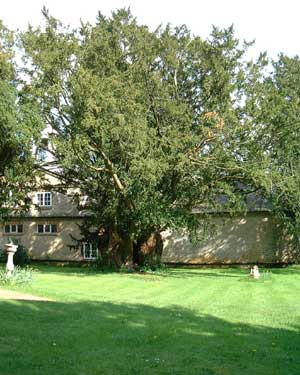
This very old Yew tree is believed to be as much as 1000 years old.
The main trunk is split in two and this usally happens to yew trees when they are about 600 years old. An adult can easily get through the split.
The Tree Register specialist says of this tree :
The Churchyard Yew is one of the country's oldest trees, and likely to be a little over 1000 years old.
goto to Top
Churches Heritage Trust
In 1995, local residents formed a Trust with the sole purpose of ensuring the preservation of the fabric and contents of the two churches in the area - St. Mary's at Shackleford and St. Nicholas at Peper Harow. Both churches are of great historical and architectural interest.
The churches are a rich and living inheritance which we have a responsibility to preserve and pass on to future generations. They are a significant part of our historical and architectural heritage and an integral and beautiful feature of the landscape of our villages.
We believe they belong to everyone and not just the worshipping congregation. Many who are not regular churchgoers still wish to use the churches for weddings, christenings and funerals and to attend special services at Christmas, Remembrance Day and Easter.
It is inevitable that these buildings, over the years, will need regular maintenance and restoration. Hence our concern and the reason for setting up the Trust.
goto to Top
The story of St. Nicholas Church, Peper Harow....
....... and some of the characters associated with it.
The church is dedicated to St. Nicholas and has been a parish church since before 1301. St. Nicolas was a real person but all the stories concerning him are purely legendary. He was Bishop of Myra in the 4th century and he has always been regarded as the patron saint of spinsters, children, sailors and scholars. He even came to be regarded as the patron saint of robbers from an alleged adventure with thieves whom he compelled to restore some stolen goods to their rightful owners.
It was Theodore of Tarsus, Archbishop of Canterbury, 668-690, who began to divide England to dioceses and parishes, but this was done very gradually and not completed until long after his day. Originally the monks at Oxenford served this church before they moved to Waverley Abbey after some disastrous floods at Oxenford when some monks and cattle were drowned. There is an interesting list of rectors of Peper Harow on the wall near the vestry door. Among them is Michael Haydock who contrived to remain rector after the execution of Charles I and throughout the Commonwealth. Dr. Manning, the historian, who wrote the history of Surrey, died in 1801 and was not only rector of Peper Harow but also vicar of Godalming and canon of Lincoln. His signature is in the marriage registers.
The registers of baptisms, marriages and burials date from 1697. Before this date they were kept in the old rectory on the north side of the church. This rectory was destroyed by fire in 1697 when Dr. Mead was rector. The church registers are now kept in the 17th-century safe in the vestry. It is interesting to see the parish records which recalled that clothing, blankets, flannel, medicine and even brandy were distributed to the poor of the parish long before what is now known as the Welfare State. Boots cost six shillings and there is a record of the purchase of one gallon of brandy for 15 shillings and sixpence. Every girl "on going out to work" was given 10 shillings by the Church.
Note the old chest in the vestry dated 1634 with the letters R.W. carved on the lid. It belonged to Robert Wood, a former rector.
In the chancel there is a brass to Joan Brocas, 1487, kneeling in prayer in her widows veil and mantle. The first husband was John Adderley, Lord Mayor of London a generation before Dick Whittington. Her second husband was William Brocas, Lord of Peper Harow.
Another attractive memorial is to Elizabeth Wood, 1621, in a peaked bodice and high collar. She was the daughter of the rector at the time.
There are is a brass inscription to Henry and Jane Smith, 1635, who lived at Peper Harow and were happily married for 48 years.
On the north wall of the chancel, outlined in marble, is a portrait of Christopher Tonstall, "a faithful pastor of this place" in Stuart times. In the centre of the chancel floor there is a memorial stone to Bridget wife of Robert Holdsworth who died in 1724. Note the curious inscription in verse. On the chancel wall there is a memorial to Thomas Brodrick, Vice Admiral of the Reds, in the days when the British Navy was divided into three squadrons, Red, White and Blue. He was a distinguished eighteenth century sailor.
As a lieutenant, he commanded the storming party when Admiral Vernon captured Porto Bello, one of the few successes in the war, in 1739. Later in the Seven Years War Thomas Brodrick was sent to the Mediterranean with reinforcements for Admiral Byng. Later when Admiral Byng was brought home under arrest and made the scapegoat for the government's failure at Minorca, Admiral Brodrick was a member of the court martial which sentenced the unfortunate Admiral Byng to death for what was not his fault. Admiral Byng was shot on the quarterdeck of his own ship in Portsmouth Harbour "pour encourager les autres", as Voltaire put it.
The recumbent figure in marble in the nave is the fourth Earl of Midleton.
Note the church roof - in the chancel and in the nave.
The ancient yew tree in the churchyard is probably more than 600 years old.
It was the wood from such trees which was used to make the famous English long-bows which we read about in history.
In the churchyard are buried many famous people, among them former Earls of Midleton and Sir Henry Dalrymple White who led the charge of the Heavy Brigade at the Battle of Balaclava.
The church was restored in 1877 and the old pews were replaced. Originally there was a gallery at the west end but this was removed in 1877 to make room for the present organ.
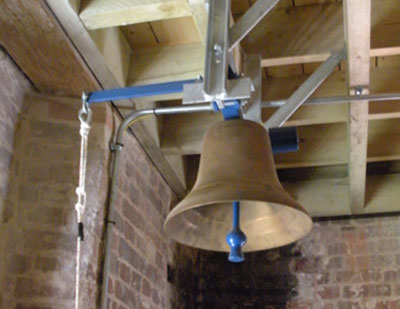
There are three inscribed bells in the church tower.
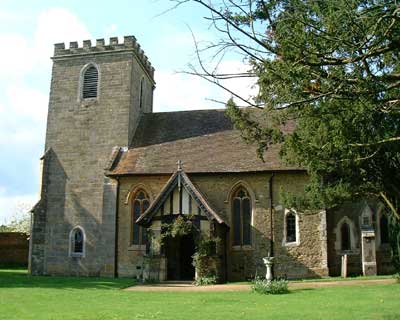
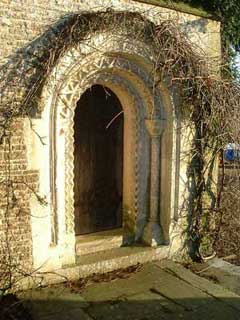
Note the plain Norman doorway to the church and the old sundial, the arm of which is missing, from the South wall.
goto to Top
Past Rectors of St Nicholas Church.
The Rev. Laurence William Eliot was Rector of Peper Harow for 61 years, 1801-1862. In the last two years he had a Curate! (Who pushed the Bath Chair!?) Surely a course record?
The Rev. William A. Shaw was Rector of St. Nicholas, Peper Harow c. 1912-1932. He attended Magdalene College, Cambridge followed by The Ely Theology College in 1890. He was made a Deacon in 1881, Priest in 1892 and acted as Curate of Netley (Southampton) between 1891-92. He had 6 children.
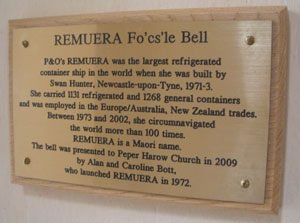
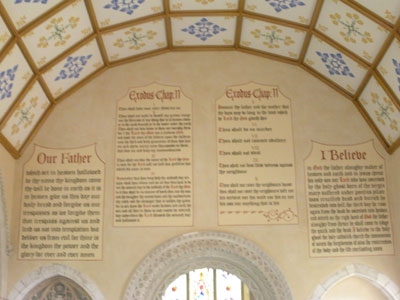
goto to TopThe Brass Plaque on the Bell from the Nomura - Reinstated Ceiling - Bell.
 Special Services (exact dates unknown)